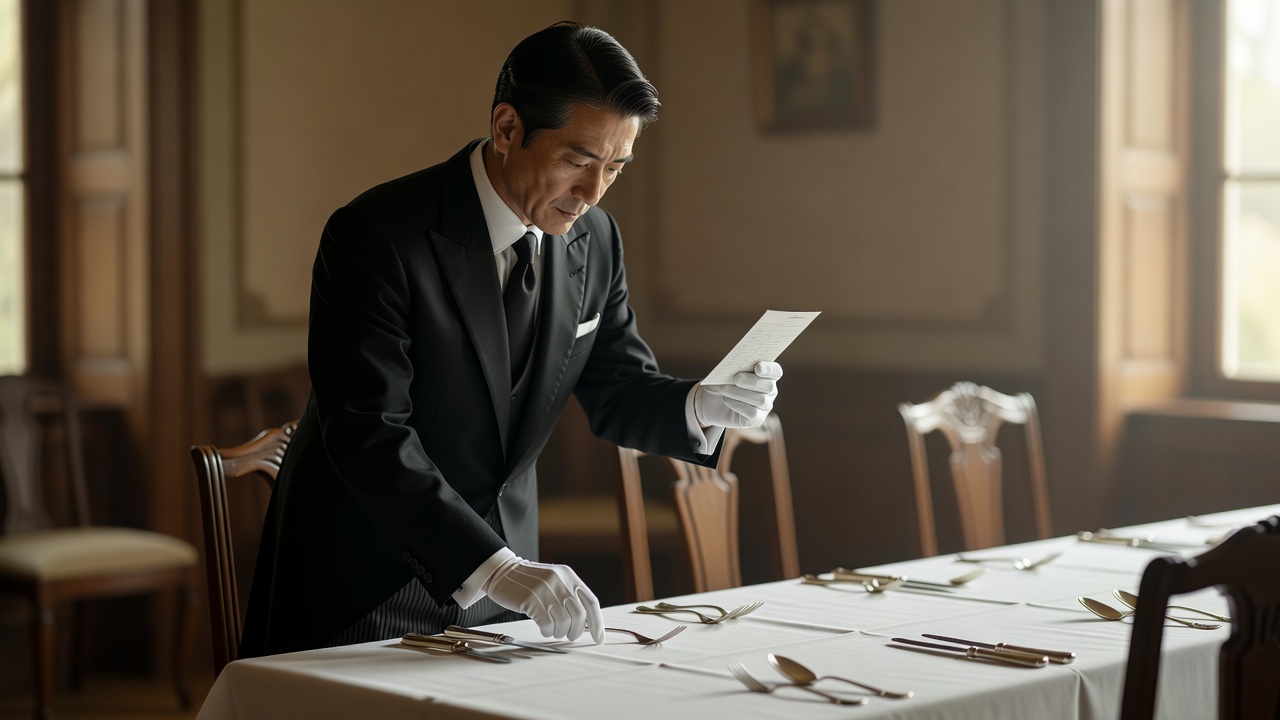
My work as a butler is not about waiting for instructions before acting. It is about anticipating needs and preparing everything in advance so that instructions are never required.
From morning preparations to receiving guests, managing the dining table and closing the house at night, each day follows a set pattern combined with on-the-spot judgements.
Here, from my perspective as Butler Bell, I share the flow of an actual day and the decision-making criteria used on the job.
Where does a butler’s day begin?
It begins in the hours when no one is watching. Before my employer stirs, I confirm the day’s schedule, the weather, any health considerations and whether guests are expected, then complete all necessary preparations.
The first task each morning is confirmation. I review the day’s appointments, the weather outside and any matters carried over from the previous day. From there I work backwards to decide exactly when each item must be ready.
I straighten the entrance, lay out the appropriate shoes and umbrella, and prepare beverages. Any lapse at this stage leaves one playing catch-up for the rest of the day. Preparation is simply time paid in advance to avoid later haste.
Once preparations are complete I survey the whole house. I check for anything left in walkways, ensure lighting is appropriate and confirm the rooms are quiet.
A comfortable room is usually achieved by subtraction rather than addition; removing what is unnecessary is more effective than adding anything new.
When guests are expected, what must be decided first?
I settle the route of welcome and the timing in advance. Deciding where to receive them, which room to show them to, what to serve and how long the visit should last removes any hesitation on the day itself.
The most important aspect of receiving guests is to spare them decisions. They should never have to wonder which way to go, where to sit or when to leave. The more choices a guest must make, the more they feel obliged to be considerate.
By preparing a clear path beforehand, the visitor can relax without thinking. Hospitality also means reducing the number of judgements the other party has to make.
The timing of serving drinks is likewise deliberate. Too early interrupts conversation; too late creates an awkward pause. I watch for a natural break, place the drink quietly and keep any words to a minimum.
A butler enters the room only to preserve its atmosphere, never to draw attention to himself.

What does a butler observe while managing the table?
I watch the guests more than the food. I note whose plate is barely touched, whose glass is nearly empty and whether conversation is becoming one-sided, looking for the right moment to intervene with the least possible movement.
Standing at table is not only about serving. It is about surveying the whole scene and supplying whatever is needed with minimal motion.
When a glass is almost empty I refill it; when a plate stops moving I check whether to clear or offer more; when talk falters I avoid any clatter while clearing. Most of the time the correct action is to remain still rather than to move.
There are also established ways of handling silver and china. One avoids noise, prevents reflections that disturb the eye and never reaches across a guest.
These details may seem small, yet when they accumulate they change the entire atmosphere at table.

When plans go awry, what guides the decision?
The employer’s purpose always comes first. Arrangements exist to serve that purpose; if the purpose is protected, the arrangements may be altered. That is the order of priority.
Things rarely proceed exactly as planned. A guest may stay longer than expected, the weather may change or someone may feel unwell. In such moments the essential question is what must be protected and what may be set aside.
What must be protected is the employer’s purpose, not the timetable I created. Clinging to the timetable at the expense of the purpose is the mistake I most wish to avoid.
When in doubt I ask myself whether I could explain the choice afterwards in a single sentence. If the reason can be stated clearly, the decision stands; if not, it is wiser to seek confirmation first.
This distinction separates independent judgement from mere presumption.
What does a butler do at the end of the day?
I prepare for the following day and record what occurred. Noting what happened, what was appreciated and what was lacking allows the next day’s arrangements to be refined.
The evening close consists of clearing, preparation and record-keeping. I return used items to their places, set out what will be needed the next morning and check that fires are out and doors secured.
Only then do I jot down any observations from the day. Preferences change, as do health and the seasons; without notes one ends up confirming the same details repeatedly.
This daily accumulation determines the quality of work months and years later. A butler’s day contains few dramatic moments. Yesterday’s note makes tomorrow slightly smoother, and those small gains compound over a year.
The quiet parts of the work contain its real substance.

Does a butler ever have time off?
Working patterns depend on the contract. Some posts require constant presence; others call for attendance only at set times. The latter arrangement has become more common.
Live-in service was once the norm, yet it is now equally usual for a butler to attend only when required. The household runs itself on ordinary days and calls upon the butler for guests or special occasions.
This approach allows a family to benefit from professional service without altering its daily life. The most suitable arrangement naturally varies with each household’s circumstances.
For details of engagement or consultation, please visit the official site of THE BUTLER, which arranges butlers. This site is devoted to the profession itself.
Frequently Asked Questions
Could you summarise the butler’s duties?
The role covers the overall running of the household: morning preparations, receiving guests, managing the dining table and closing the house at night, together with all necessary arrangements and the direction of staff.
Organisation, rather than the physical tasks themselves, forms the core of the work.
What does a typical day look like?
It begins with checks and preparations before the employer rises, continues with guest reception and table service during the day, and ends with clearing, next-day preparations and a brief record of the day’s events.
Preparation occupies the largest share of time.
Does a butler also clean and cook?
Sometimes, though that is not the purpose of the role. In houses with other staff the butler directs them; in smaller households the butler may perform the tasks personally. Responsibility always extends to the entire operation of the house.
How does a butler decide when plans change?
The employer’s purpose takes precedence. Arrangements are only a means to that end, so the procedure may be altered if the purpose remains secure. The test is whether the reason for the change can be explained in a single sentence.
Related Pages
Consultation on the Butler’s Work
I welcome enquiries regarding interviews, lectures and training on the profession of butler.
Go to Contact