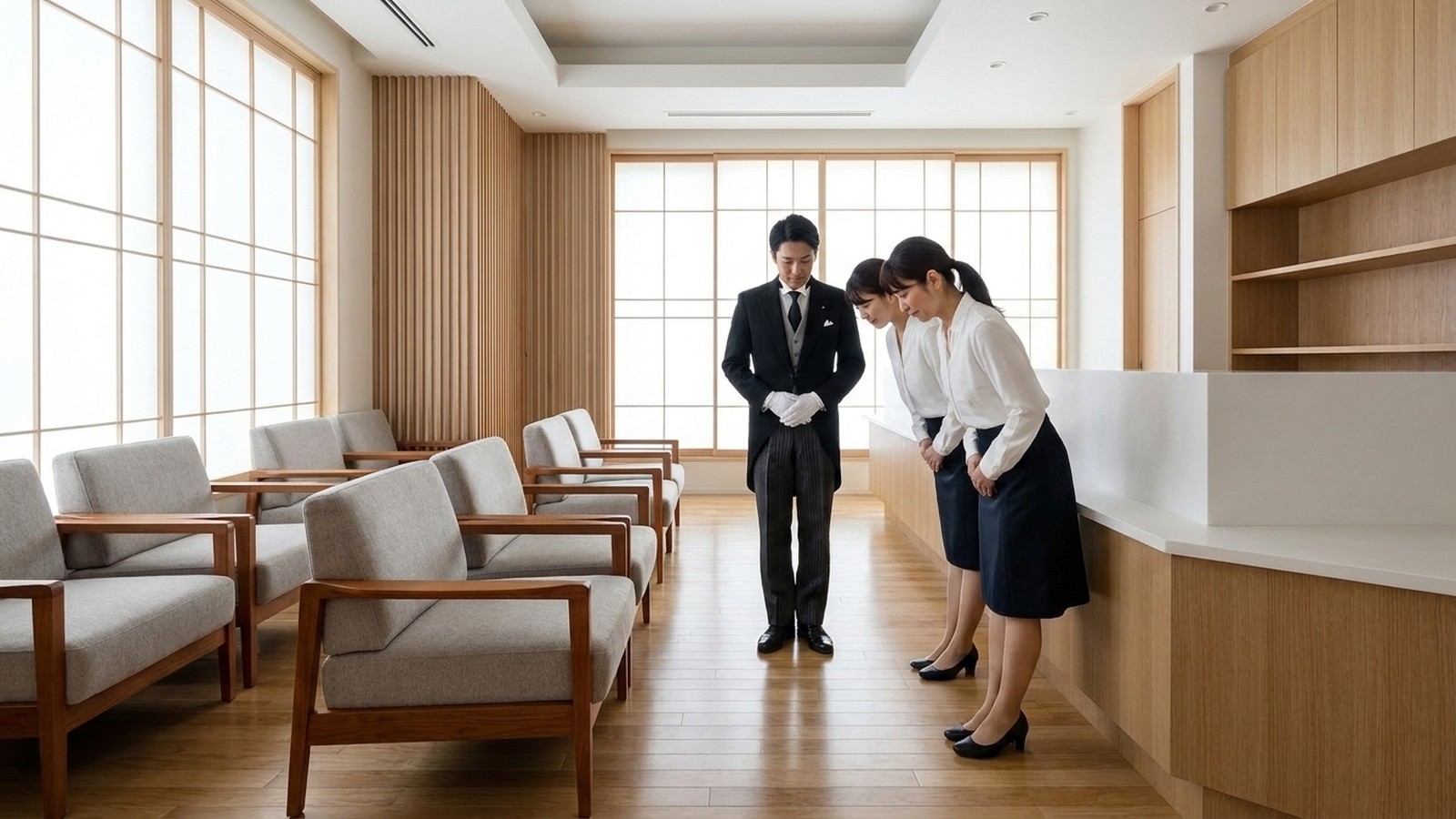
The Japan Butler Academy is the training institution where the skills of a butler may be studied in a systematic fashion. Through lectures one grasps the reasons, and through practical training these become second nature.
By repeating this cycle we ensure that the manners never remain mere form.
Here, from my position as head (Todori) of the All Japan Butler Association, I introduce the overall picture of the learning and the path by which what is learned leads to actual duties.
How one learns
We move back and forth between lectures and practical training. After understanding the reasons one moves the body, and after moving one understands again. This repetition allows the manners to take root.
If one merely memorises the manners, they cannot be applied in unexpected situations. When one understands why a certain order or position is required, one can still judge correctly even when circumstances change.
Someone must always watch
Theory alone, however, will not set the body in motion. That is why we have adopted this alternating structure.
A form with its reason survives
In practical training there are areas where one cannot notice one’s own mistakes. We always include the step of having someone observe and correct.
Another gain from the back and forth is that things are learned faster. A shape copied without its reason has gone by the following week. A form whose position has once been understood survives even after months away.
What one learns
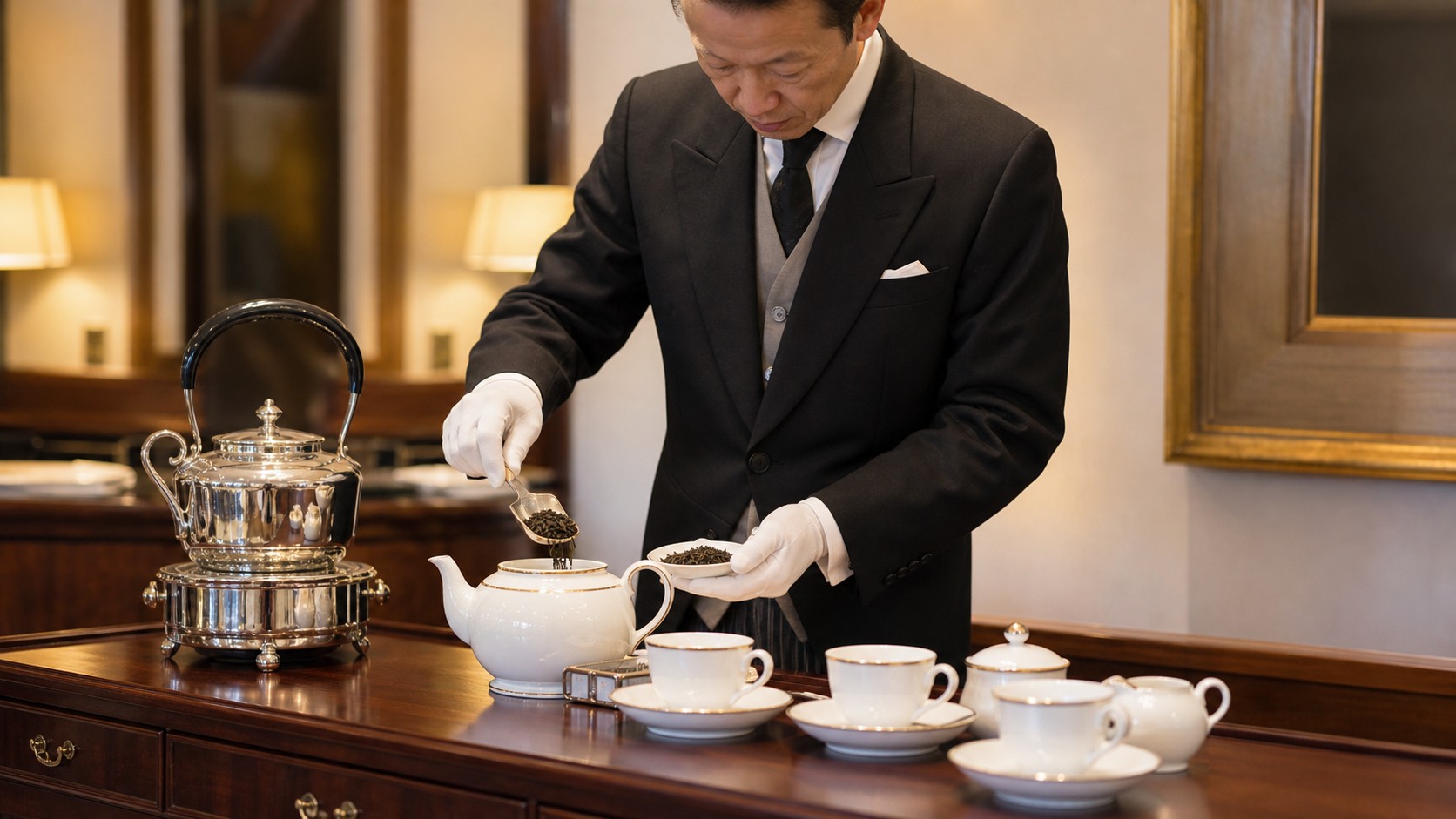
We cover, in stages, the fundamentals of service, the arrangement of the table, the handling of beverages, dress and grooming, record-keeping and confidentiality, and etiquette in international settings.
Although the range is broad, there is a proper order.
Meeting guests from abroad
First come the fundamentals of service and observation, then concrete skills such as table and beverage work, and only after that do we proceed to handling the unexpected and directing several people.
Depth changes with the course
Learning higher content without the foundations will not take hold.
We also address etiquette in international settings. Opportunities for Japanese butlers to meet overseas guests are increasing, and the Association places emphasis on internationalisation.
Because the ground covered is wide, the depth of each part changes with the course. In Essential one method of making tea is brought to certainty; the higher courses open out into the differences between leaves. Multiply the options at the start and none of them settle.
Reception and observing
Table and drink
The unforeseen, and directing

Are the courses divided
Courses at different levels are provided according to purpose. They are divided into a curriculum that begins with the fundamentals, one that moves into practical duties, and one that covers overall supervision.
Those who aim to work as butlers and those who wish to study the subject as a cultural accomplishment require different depths of knowledge. The levels are separated so that each person may choose the manner of study suited to their purpose.
Dates and terms sit with the school
Details of each course, its duration and entry requirements may be found on the official website of the Japan Butler Academy.
Returning for a further course
Some return to take a further course later: finishing Essential, working for some years, then coming back for Advance. A student with practice in between takes something different from the very same lecture. We do not recommend running straight through to the higher courses.
What happens after one has learned
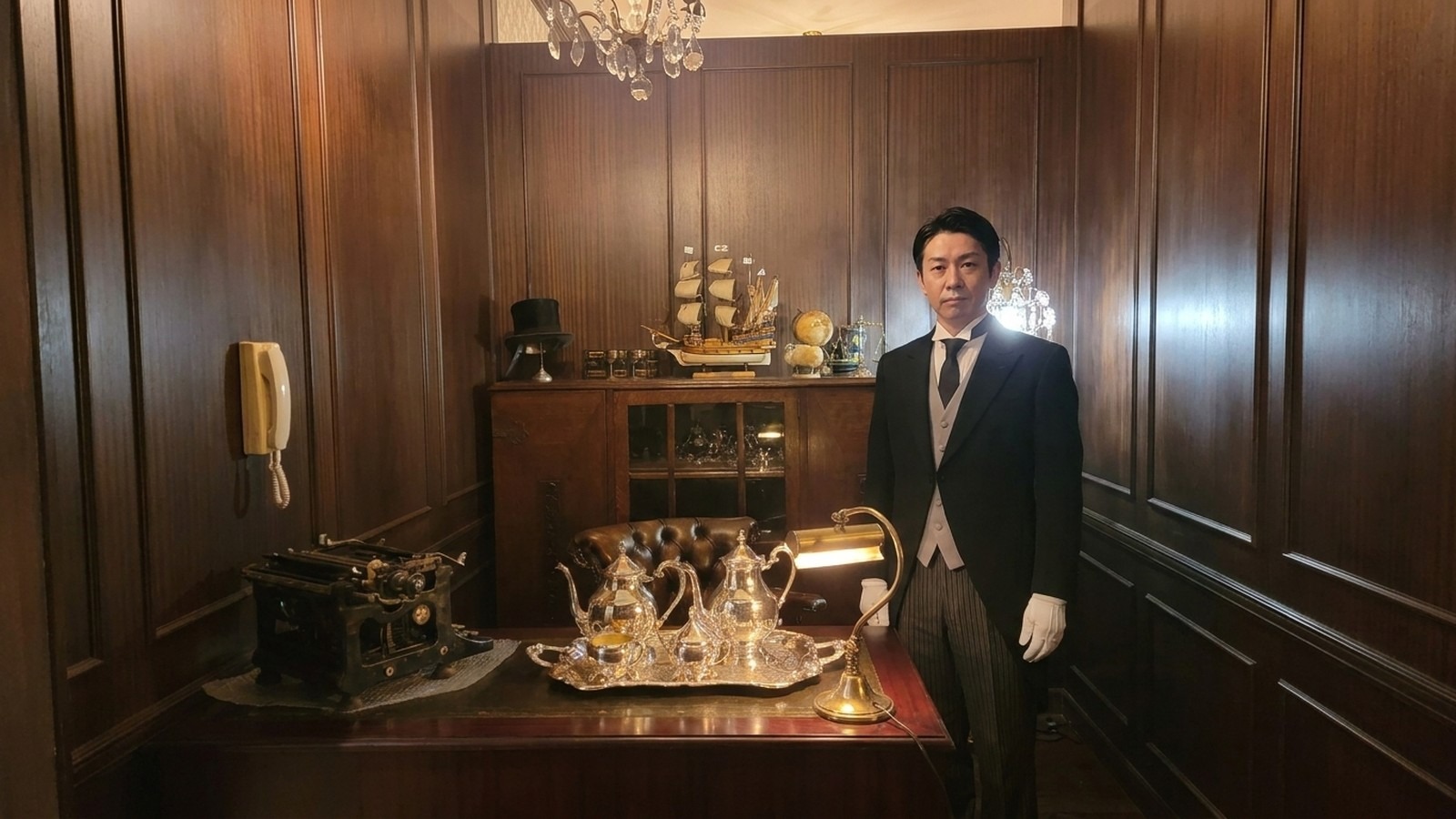
After passing the practical examination at the end of the course, there is a route to Association certification. Butlers who obtain certification may take up positions in actual service.
So that learning does not remain learning alone, training, certification and going out to work form a single continuous process. Butlers who receive Association certification after completion are sent to the places where they are needed.
The grades are on the association's page
The stages of certification and the principles of assessment are explained on the Association’s certification page.
Choosing not to be certified
Not going on to certification is also a choice. Some finish the course without sitting the assessment, and the learning is not wasted for that. A grade is needed in order to stand in a household; the value of the learning itself sits apart from it.
Who studies here
It is not only those who wish to become butlers. People who wish to improve the quality of their service and those who wish to learn etiquette as a cultural accomplishment also attend.
Participants include those engaged in the hospitality industry, those responsible for receiving guests in companies, and those who wish to perfect hospitality in the home; motives vary.
Neither age nor experience is asked
Many aspects of a butler’s skills can be applied in daily life even if one does not pursue the occupation.
Twenties and sixties at one table
Age and prior experience are not required. Many begin their studies after gaining social experience.
A wide spread of ages is another mark of this school; people in their twenties and their sixties practise at the same table. The younger take the speed of arrangement, the older the settling of a room, each from the other. Some things pass that way faster than an instructor can teach them.

What we have decided not to teach
The ready smile, the over-polite register, the phrases that flatter. A school of customer service may teach them; this course does not.
In building the course, the first list drawn up was not of subjects to teach but of subjects to leave out: how to shape a smile, how to lift the voice, the turns of phrase that praise a guest into ease. All useful in service work; none of them in a butler's course.
Because we do not lift the other person
They were left out because a butler is not there to lift anyone. Being lifted obliges the other person to respond in kind. What a butler should do is create a state in which nothing needs to be returned at all: stand quietly, move only when needed. That shape is taught from the first day.
The smile from an earlier job is not confiscated
Some students take a while to set aside the smile learned in an earlier job. It is not a bad habit, so it is not confiscated; they are taught instead that there are occasions where it is not used.

There is a day when nothing is taught
Once in the middle of the course the instructor teaches nothing. Whether a form has become your own only shows on a day when no one tells you.
Midway through the course comes a day when the instructor announces that nothing will be taught. That afternoon's tea is run by the students alone. Who boils the water, who lays the table, who goes out if the visitor arrives early. From the order of work to the clearing away, they decide it themselves.
Something usually comes apart
In most runs something comes apart: the table is laid before the water boils, two people go for the same vessel, no one is watching the door. Recovering from the collapse is part of the exercise. The instructor watches from the corridor and says nothing.
What is written is not a reflection
What they write afterwards is not a reflection but a single sheet on what they would change if they ran the same tea again. Anyone who can set down a concrete order on that sheet can also recover a collapse in a real household.
Planning it
Watching it come apart
Recovering it
A record of the learning is kept
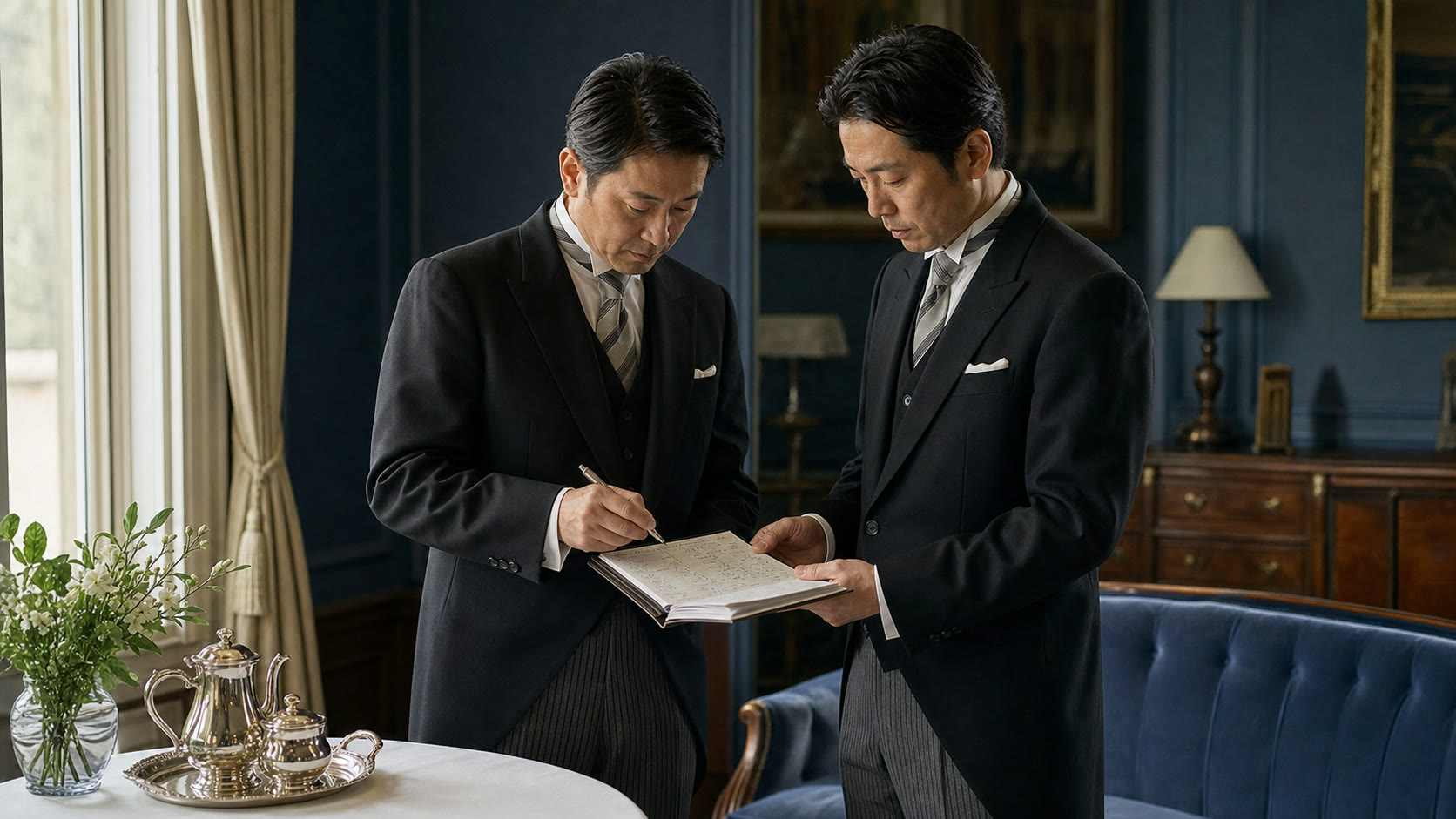
What a student receives on the first day is not a tool but a notebook. A butler's work is also the work of records, so the habit begins with the learning.
On the first day a student is handed neither silver nor gloves but a notebook. Whatever was noticed in class is written the same day and read back in the following week's room, where the instructor answers what was set down.
Writing sharpens the observing
The writing is not only to support memory. The act of putting something into a writable form sharpens the observing itself. Anyone who can only write "it did not go well" has not yet seen what happened. Once they can write "I went to the table before checking the temperature of the water", the remedy appears of itself.
The notebook goes home
The notebook goes home with them at the end. Many keep writing once they are in service, and when they return to the classroom some years later, they usually have it with them.
Frequently Asked Questions
What can one learn at the Japan Butler Academy?
One can study, in stages, the fundamentals of service, the arrangement of the table, the handling of beverages, dress, record-keeping and confidentiality, and etiquette in international settings.
The structure alternates between lectures and practical training.
Can one study without prior experience?
Yes. Because the curriculum proceeds in stages from the fundamentals, even those without experience can acquire the skills in the proper order. Many begin their studies after gaining social experience.
What happens after one has completed the course?
After passing the practical examination at the end of the course there is a route to Association certification. Butlers who obtain certification may take up positions in actual service.
Is there anything you have decided not to teach?
There is. The ready smile, the over-polite register and flattering phrases are left out. A butler does not lift the other person; he creates a state in which nothing needs to be returned.
Is it true there is a day when nothing is taught?
It is. Once during the course the students run an afternoon tea by themselves. Whether a form has become your own only shows on a day when no one tells you.
Related Pages
Consultation on learning
Details of the courses and current recruitment may be found on the official website of the Japan Butler Academy.
Go to enquiries